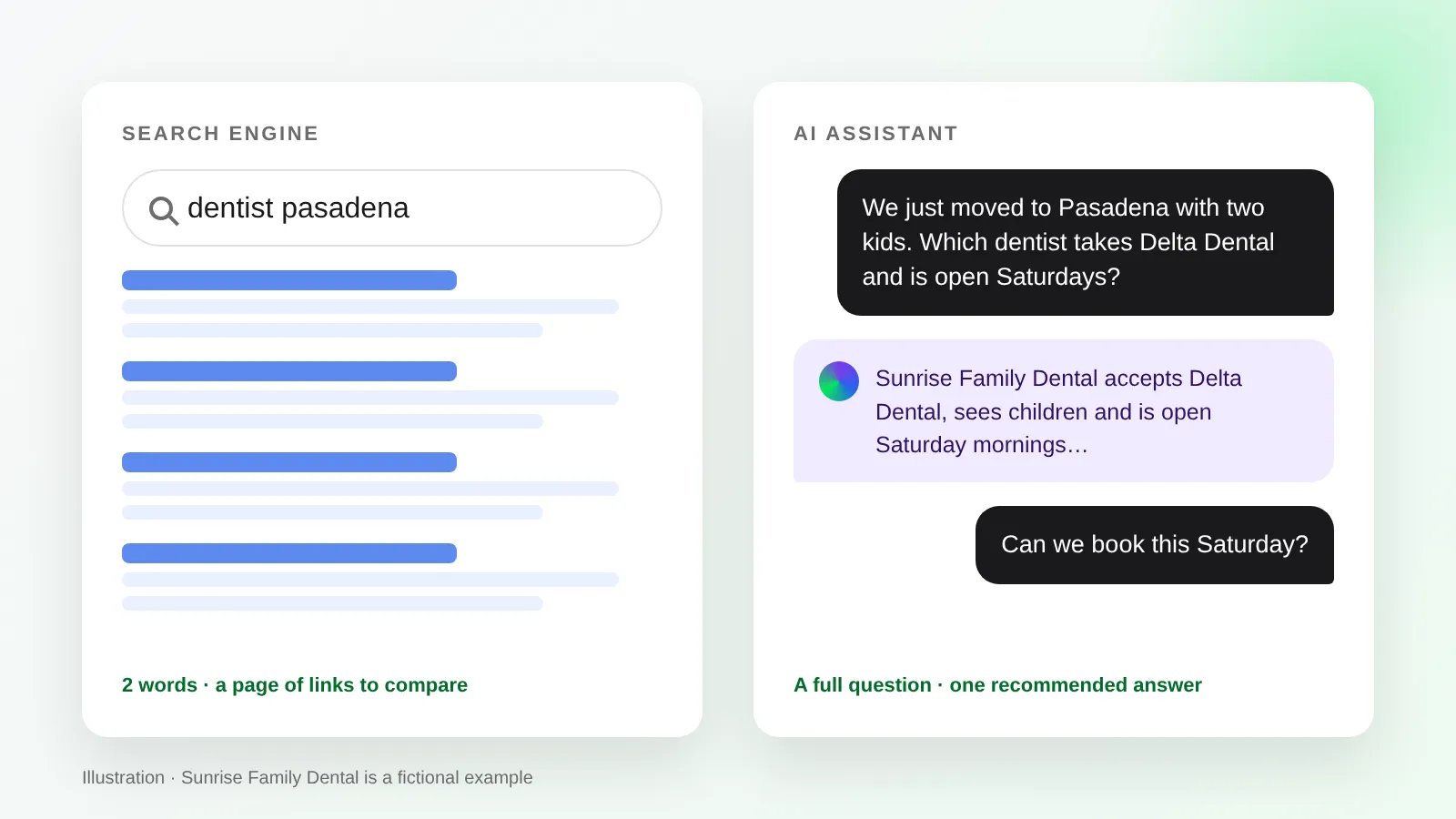
For twenty years, people searched like they were typing into a phone book: a service and a place. “dentist pasadena.” “plumber near me.” Then they compared a page of links and did the rest of the work themselves.
AI assistants changed the shape of the question. In ChatGPT, Gemini, Claude, Perplexity, Copilot or Google’s AI Mode, people describe their situation in a full sentence and expect one answer back. Google’s own product team has said that early testers of AI Mode ask queries almost two to three times the length of traditional searches.
Here’s what that looks like, why it matters for a local business, and what your website needs so it can be the answer.
The same need, asked two ways
These are illustrative examples: the kind of searches we see business owners’ customers make, not data from a specific account.
| What they type into Google | What they ask an AI assistant |
|---|---|
| dentist pasadena | We just moved to Pasadena with two kids. Which dentist takes Delta Dental and is open Saturdays? |
| emergency plumber | My water heater is leaking at 9pm in Glendale. Who can come tonight, and roughly what will it cost? |
| tow truck near me | My car broke down on the 101 near Woodland Hills. Who can tow a lowered car to a shop in Burbank? |
| liquor store delivery | Which store near Silver Lake can deliver a bottle of mezcal today, and do they check ID at the door? |
The Google version is a keyword. The AI version is a brief: location, timing, budget, insurance, who it’s for, and the deal-breakers. Each detail is a filter, and a business that doesn’t state that detail anywhere is easy to filter out.
Why longer questions change who gets picked
On a classic results page, ten businesses can each get a click. In an AI answer, there’s often room for one to three names, and the assistant picks them because their information matches every part of the question.
Google describes how this works for AI Overviews and AI Mode: they may use a technique called query fan-out, running several related searches across subtopics to build one response. Google also says AI Mode is “particularly helpful for queries where further exploration, reasoning, or complex comparisons are needed.” In plain terms, the assistant breaks your customer’s question into pieces (Delta Dental? Saturdays? kids?) and looks for pages that answer each piece.
ChatGPT works in a similar spirit. OpenAI describes its search as letting people “ask a question in a more natural, conversational way,” with answers that link to their sources.
So the question for your website isn’t only “do we rank for dentist pasadena?” It’s also “if someone asks a detailed question, does our site actually say the answers?”
What AI assistants need from your website
None of this needs a secret trick. Google states there are “no additional requirements to appear in AI Overviews or AI Mode, nor other special optimizations necessary.” What helps is being clear, complete and consistent:
- Write the facts down as text. Services, the areas you serve, hours (including weekends and after-hours), insurance or payment options, price ranges, and who you work with (kids, seniors, commercial clients). If it only lives in a photo, a PDF or your receptionist’s head, an assistant can’t use it.
- Answer real questions on the page. A short FAQ written from what customers actually ask on the phone does more than a page of slogans. This is what people mean by AEO (answer engine optimization).
- Keep your business details identical everywhere. Same name, phone, website and services on your site, your Google Business Profile, Bing Places, Apple Business Connect and directories. Mixed signals make it harder to be the confident answer.
- Use structured data that matches the page. Schema markup helps search engines read your business details, but Google is clear that it has to match the visible text.
- Let the right crawlers in. If your robots.txt or firewall blocks search bots, you can’t be cited. OpenAI, for example, says sites that opt out of its search crawler, OAI-SearchBot, “will not be shown in ChatGPT search answers.” Blocking AI training crawlers is a separate choice.
- Keep your Business Profile current. Google’s guidance for AI features specifically mentions keeping Business Profile information up to date. For local questions, it’s often where the hours and reviews come from.
Being cited in AI-written answers is what people call GEO (generative engine optimization). We explain both terms on our AI search optimization page.
What doesn’t change
Good SEO is still the foundation. To show as a link in Google’s AI features, a page has to be indexed and eligible to appear in Search with a snippet, the same requirement as regular results. A slow, hacked or hard-to-crawl site loses in both places. If you’re not sure your basics are solid, start with technical SEO and your Google Business Profile.
And an honest note: no one can guarantee placement in AI answers. Anyone who promises it is guessing. What you can control is whether your business gives assistants a complete, accurate answer to work with.
A 20-minute check you can do today
- Write down three questions a real customer asked you this month, in their words.
- Ask each one in ChatGPT, Gemini and Google (try AI Mode if you have it).
- Note who gets named, and what details the answer mentions.
- Open your own website and check: does it state each of those details clearly, in text?
Every “no” in step 4 is a gap a competitor can fill. That list is your to-do list.
If you’d rather we run that check across Google, Google Maps and the main AI assistants, our free visibility audit does exactly that and comes with a plain-language plan.
Sources
- Google Search Central: AI features and your website
- AAP News: Why Google wants you to ask long, complicated questions (quote from Hema Budaraju, Google)
- OpenAI: Introducing ChatGPT search
- OpenAI: Overview of OpenAI crawlers