
Short answer: Google Maps ranks local businesses from the searcher’s location, not from yours. Every search is scored on relevance, distance and prominence, so your position can change from one block to the next. A stronger Business Profile, steady reviews and consistent listings widen the area where you show up in the top 3.
You search for your business on Google Maps from your office and there it is, right at the top. Then a customer across town tells you they could not find you at all. Both of you are right.
Google Maps does not have one ranking for your business. It has a different ranking for almost every street in your city. Here is why that happens, and what you can do about it.
Why does my Google Maps ranking change by location?
Because Google ranks you from where the searcher is standing. When someone searches “dentist near me” or “tow truck,” Google checks that person’s location and shows the businesses it thinks are the best match for that exact spot.
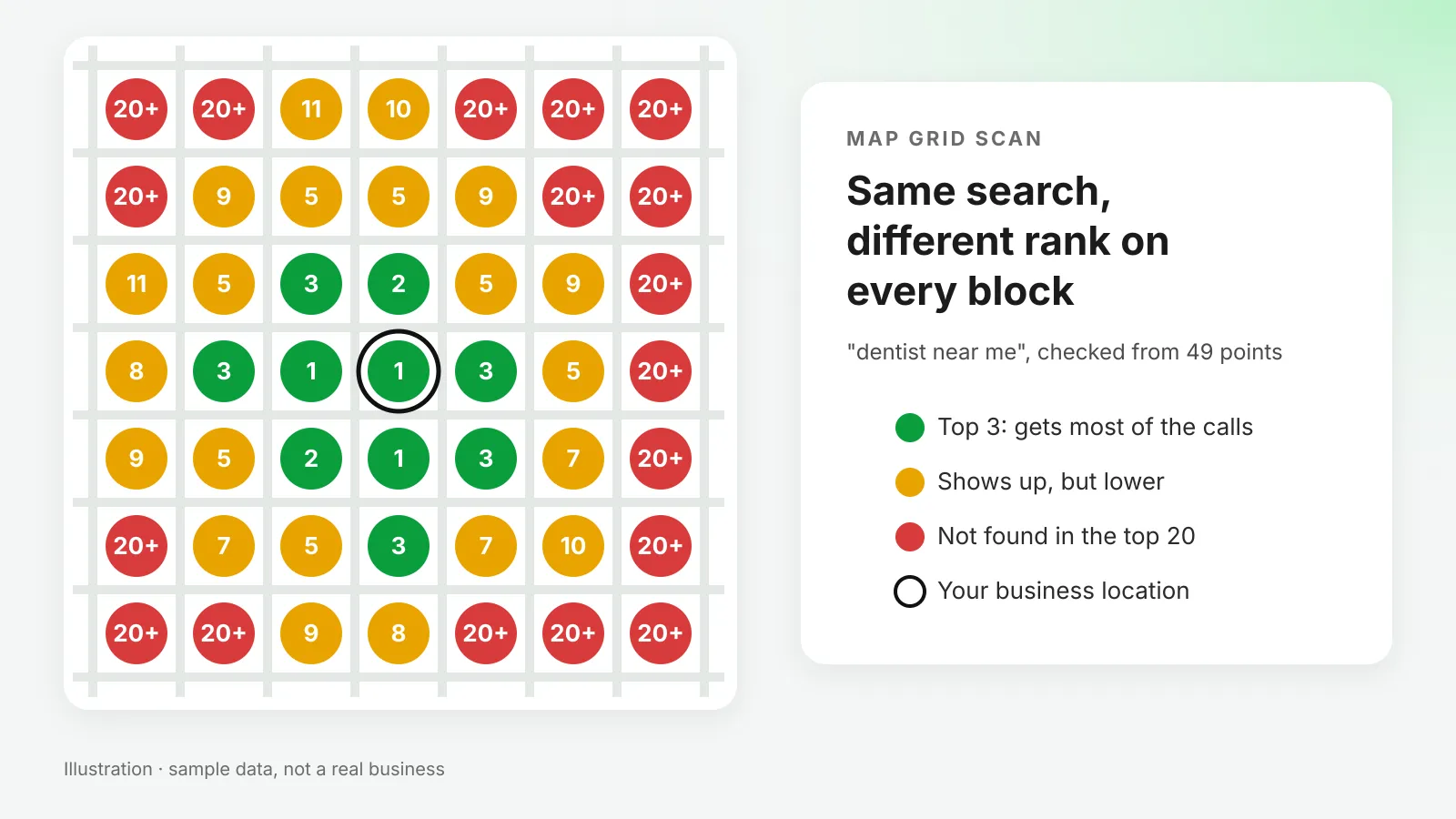
That means your ranking is not a single number. It is more like a map of numbers. You might be #1 within a few blocks of your office, #4 a mile away, and nowhere to be seen in the next neighborhood over.
This is also why checking your own ranking from your desk is misleading. You are standing in the one place where you are most likely to win.
What does Google look at to rank local businesses?
Google says local results are based mainly on three things:
- Relevance: how well your Business Profile matches what the person searched for. Your categories, services, description and reviews all play a part.
- Distance: how far your business is from the person searching, or from the area they named in the search.
- Prominence: how well known and trusted your business is. Reviews, ratings, links, citations and mentions across the web all count.
You cannot move your building, so distance is mostly fixed. Relevance and prominence are where you can win, and they decide how far your ranking stretches before a competitor takes over.
Why does a competitor beat me two miles away?
Picture each business as a circle on the map. The stronger the profile, the wider the circle. A business with a complete profile, steady reviews and accurate listings everywhere can rank well across a much wider area than a business with only a basic listing.
So when a competitor outranks you in the next neighborhood, it is usually not because they are closer. It is because their circle reaches farther than yours.
How do you measure Google Maps rankings across a city?
With a map grid scan. Instead of checking one search from one spot, we drop a grid of points across your service area, often 49 or more, and check where you rank from each point.
The result reads like a heat map:
- Green points are where you show up in the top 3, the spots that get most of the calls
- Yellow points are where you show up, but lower on the list
- Red points are where you do not show up at all
One glance shows exactly where you are winning, where you are close, and where customers cannot find you.
How do I improve my Google Maps ranking in more areas?
- Complete your Google Business Profile. Pick the most accurate primary category, add secondary categories, list every service, and keep hours, photos and your description current. See our Google Business Profile service.
- Earn reviews steadily. A regular flow of real reviews, with thoughtful replies, builds trust with customers and with Google. Ask every happy customer, the same way each time.
- Keep your name, address and phone identical everywhere. Yelp, Apple Maps, Bing Places, Facebook and industry directories should all match your Google profile exactly.
- Post regularly. Weekly Business Profile posts about your services and offers show Google your business is active.
- Build pages for the areas you serve. A helpful page for each city or neighborhood you cover gives Google more reasons to show you there.
- Earn local mentions and links. Local news, community events, partners and associations all add to your prominence.
- Track it over time. Run the same grid scan every month so you can watch your green area grow and catch drops early.
These same signals also help AI assistants like ChatGPT, Gemini and Google’s AI Overviews, which lean on business profiles, reviews and listings when they recommend local businesses. Learn more in SEO vs AEO vs GEO.
Frequently asked questions
Why do I rank first when I search from my office?
Because you are standing right next to your business, where distance works most in your favor. Customers searching from other neighborhoods can see a very different list.
Can I rank in a city where I do not have an office?
It is harder, because distance still counts. Service area businesses can grow their reach with a strong profile, reviews from customers in that area, and a helpful page about the area on their website.
How long does it take to improve map rankings?
Most businesses see movement in a few weeks to a few months, depending on competition and how much of the profile, reviews and listings work is needed. Monthly grid scans show the progress.
Does Apple Maps work the same way?
Apple Maps also weighs location, relevance and reputation, but it uses its own data, including Apple Business Connect and Yelp. A complete Apple Business Connect listing matters for iPhone users.
The bottom line
If you only check your ranking from your own office, you are seeing the best case. Your customers are searching from everywhere else. The businesses that win on Google Maps look at the whole map and keep pushing their coverage out, block by block.
Want to see your map?
We will run a free map grid scan for your business and show you exactly where you rank across your service area, plus what to fix first. Explore our local SEO services, get your free visibility audit or schedule a call.