
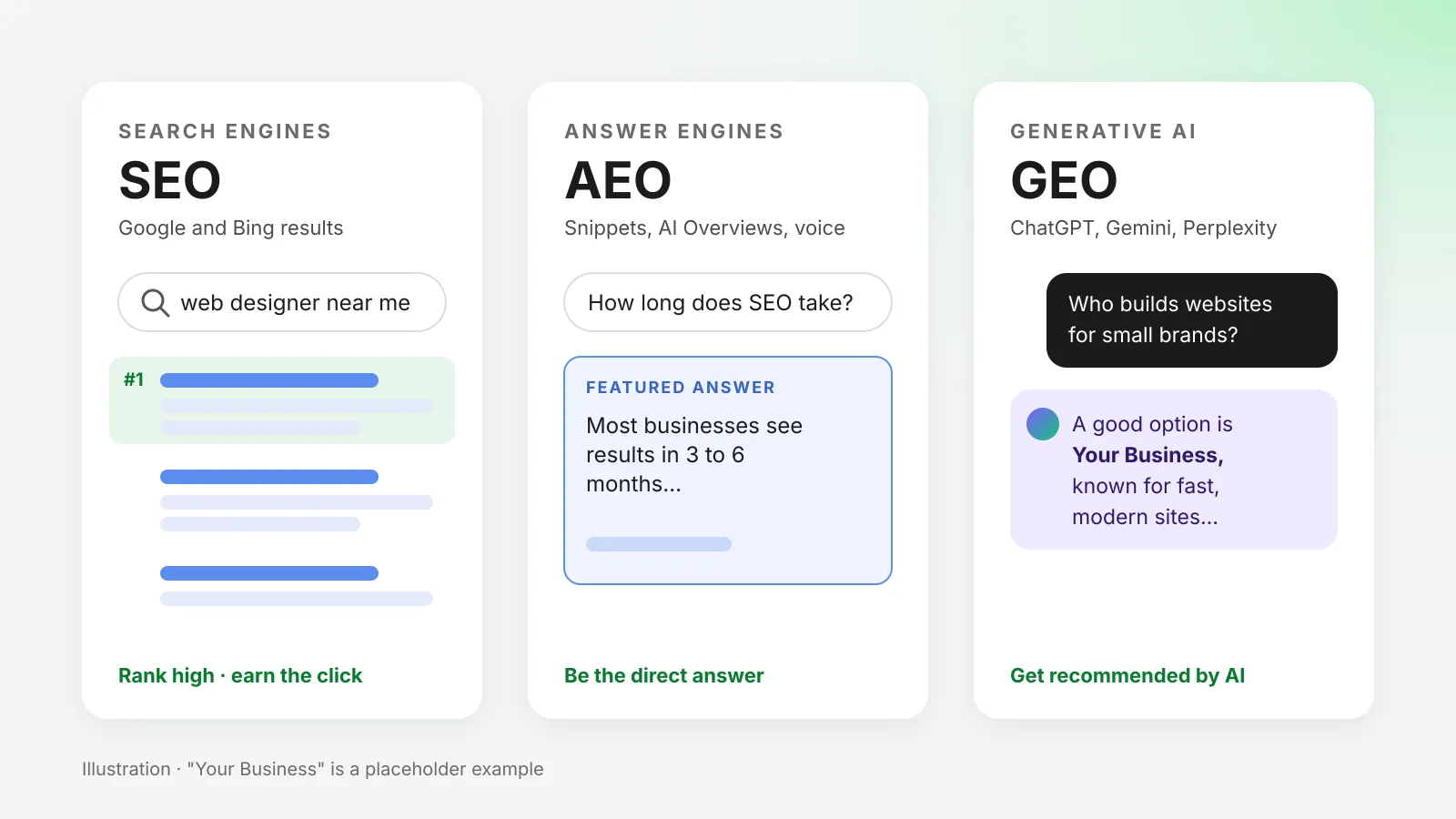
The way people find businesses online has changed. A few years ago, getting found meant ranking on page one of Google. Today, your customers might type a question into Google, ask ChatGPT for a recommendation, check Google Maps for someone nearby, or simply ask their phone. Each of those moments is a chance to be found, or to be skipped.
That is where SEO, AEO and GEO come in. They sound like alphabet soup, but they are really three sides of the same goal: making sure the right people find you, trust you and choose you. In this guide, we break down what each one means, what technical SEO is and why it matters, and how website SEO differs from local business SEO.
What is SEO?
SEO stands for Search Engine Optimization. It is the practice of improving your website so it shows up higher in search results on Google, Bing and other search engines when people search for what you offer.
Good SEO usually comes down to four things:
- Relevant content that answers what your customers are actually searching for
- Keywords placed naturally in page titles, headings and copy
- Authority, built through quality backlinks, reviews and mentions from trusted sites
- A healthy website that loads fast, works on mobile and is easy for search engines to read
The goal of SEO is simple: earn the click. When someone searches “web design agency Beverly Hills” or “emergency dentist near me,” you want your link to be the one they choose.
What is AEO?
AEO stands for Answer Engine Optimization. It focuses on getting your content chosen as the answer, not just one link in a list.
Think about featured snippets at the top of Google, the “People also ask” boxes, Google’s AI Overviews, and voice assistants like Siri, Alexa and Google Assistant. In all of these, the search engine pulls a short, direct answer from a website and shows it right away. Often, the person never clicks anything. They just get the answer, along with the name of the business that provided it.
To optimize for answer engines, you:
- Write clear, direct answers to common customer questions, usually in the first sentence or two
- Use question-style headings, like “How long does a dental implant take?”
- Add FAQ sections to key pages
- Use structured data (schema markup) so search engines understand what your content is
- Keep answers short, factual and easy to quote
AEO is about being the trusted source, even when no one clicks.
What is GEO?
GEO stands for Generative Engine Optimization. It is the newest of the three, and it is all about AI tools like ChatGPT, Google Gemini, Perplexity, Claude and Microsoft Copilot.
More and more people are asking these tools for recommendations: “What is a good towing company in Simi Valley?” or “Who builds Shopify stores for small brands?” The AI writes an answer by pulling from information it finds across the web. GEO is the work of making sure your business shows up in those answers, and that what the AI says about you is accurate.
GEO focuses on:
- Clear, consistent business information everywhere online, so AI tools describe you correctly
- Expert, in-depth content that AI models see as credible and worth citing
- Mentions and citations on trusted sites, directories, news outlets and review platforms
- Entity clarity, meaning the web clearly understands who you are, what you do and where you do it
- Fresh, factual content with real details, numbers and examples rather than generic filler
Where SEO earns the click and AEO earns the answer box, GEO earns the mention inside the AI’s response. Learn more about our AI search optimization service.
SEO vs AEO vs GEO at a glance
| SEO | AEO | GEO | |
|---|---|---|---|
| Stands for | Search Engine Optimization | Answer Engine Optimization | Generative Engine Optimization |
| Where it shows up | Google and Bing search results | Featured snippets, AI Overviews, voice assistants | ChatGPT, Gemini, Perplexity, Copilot and other AI tools |
| The goal | Rank high and earn the click | Be the direct answer | Be mentioned and recommended by AI |
| What wins | Relevant content, keywords, backlinks, site health | Clear Q and A content, FAQs, schema | Authority, consistent info, citations, expert content |
| How you measure it | Rankings, traffic, conversions | Snippet wins, impressions, voice visibility | AI mentions, citations, brand accuracy |
The good news: these strategies overlap a lot. Strong, well-organized, trustworthy content helps you win in all three.
What is technical SEO?
Technical SEO is the behind-the-scenes work that makes your website easy for search engines and AI tools to find, crawl, understand and rank. If content is what you say, technical SEO is making sure the message actually gets delivered.
You can write the best content in your industry, but if Google cannot crawl your pages, your site loads slowly, or it breaks on mobile, that content will struggle to rank.
What technical SEO covers
- Site speed and Core Web Vitals: how fast your pages load and how stable they feel while loading
- Mobile friendliness: your site works and looks great on phones, where most searches happen
- Crawlability and indexing: search engines can reach your pages and add them to their index
- XML sitemap and robots.txt: a clear map of your site and rules for what search engines should crawl
- Site structure and internal links: a logical layout so visitors and search engines can move around easily
- HTTPS security: a secure site that protects visitors and earns trust
- Structured data (schema): code that tells search engines exactly what your business, services, reviews and FAQs are
- Fixing errors: broken links, redirect chains, duplicate content and 404 pages
- Canonical tags: telling search engines which version of a page is the main one
- Accessibility: a site everyone can use, which also tends to help search performance
Why technical SEO matters
Technical SEO is the foundation. It helps you:
- Get found: pages that cannot be crawled or indexed simply do not show up
- Rank higher: speed, mobile experience and security are all ranking factors
- Keep visitors: a fast, smooth site keeps people around instead of sending them back to the search results
- Convert more: a site that works well turns more visitors into calls, bookings and sales
- Show up in AI answers: clean structure and schema make it easier for answer engines and AI tools to understand and cite your content
Without a solid technical foundation, every other SEO effort has to work much harder. See how we handle technical SEO.
Website SEO vs local business SEO
Not every business needs the same kind of SEO. The right approach depends on who your customers are and where they are.
Website SEO (often called organic or national SEO) helps your site rank for topics and keywords no matter where the searcher is. It is ideal for online stores, ecommerce brands, SaaS companies and businesses that serve customers anywhere.
Local business SEO helps you show up when people nearby search for what you offer, especially in the Google Map Pack, Google Maps and “near me” searches. It is essential for dentists, towing companies, restaurants, real estate agents, salons, contractors and any business that serves a specific city or area.
| Website SEO | Local Business SEO | |
|---|---|---|
| Who it is for | Online stores, national brands, service businesses that work anywhere | Businesses that serve a specific city, region or service area |
| Main goal | Rank in organic search results across the country or world | Rank in the Map Pack, Google Maps and local results |
| Key focus | Content, keywords, backlinks, technical SEO | Google Business Profile, reviews, local citations, location pages |
| Example search | “best organic skincare for dry skin” | “emergency dentist in Encino” |
| Trust signals | Backlinks and authority | Reviews, ratings and a consistent name, address and phone (NAP) |
| Competition | Every site ranking for that topic | Other businesses in your area |
What local SEO includes
- A complete, optimized Google Business Profile with photos, services, hours and regular posts
- A steady flow of genuine customer reviews, with thoughtful replies
- Consistent NAP (name, address, phone) across directories like Yelp, Apple Business, Bing Places and industry sites
- Location and service area pages on your website
- Local schema markup so search engines know exactly where you are and what you do
- Local content and links, like community involvement, local news and partnerships
Which one do you need?
If customers come to you, or you go to them within a certain area, local SEO should be your top priority. If you sell online or serve clients anywhere, website SEO is your main focus.
Many businesses need both. A dental practice wants to win “dentist near me” in its neighborhood, and also rank for helpful topics like “how long do veneers last.” A retail brand with a physical store wants local shoppers, and also online buyers nationwide. Our local SEO services cover the local side.
How it all works together
Think of it as one connected system:
- Technical SEO builds the foundation so search engines and AI can access and understand your site
- SEO (website and local) helps you rank and earn clicks from the people searching for you
- AEO gets your answers featured in snippets, AI Overviews and voice search
- GEO makes sure AI tools like ChatGPT and Gemini know about your business and recommend it accurately
Search is no longer just ten blue links. The businesses that win are the ones that show up everywhere their customers are looking, with a fast site, helpful content, and information that is clear and consistent across the web.
Frequently asked questions
Is SEO dead because of AI?
No. AI tools and answer engines still rely heavily on well-optimized, trustworthy websites. Strong SEO is the foundation that AEO and GEO build on.
Do I need to do SEO, AEO and GEO separately?
Not really. Most of the work overlaps. Clear content, good structure, schema and a strong reputation help in all three. The difference is mostly in how you format content and where you track results.
How long does SEO take to work?
Most businesses start seeing meaningful movement in three to six months, depending on competition, the current state of the website, and how consistently the work is done. Local SEO can sometimes show results faster.
What is the first step?
Start with an audit. A technical SEO and local SEO audit shows what is holding your site back and which fixes will make the biggest difference first.
Ready to get found?
At Elash Design Studio, we help businesses show up where it matters, from Google search and Google Maps to AI answers. Whether you need a technical SEO audit, a local SEO strategy, or a website built to rank from day one, we are here to help.
Schedule a call or start a project and let’s talk about how to grow your visibility.